Multimodal curtainsiders at Spedition Bode
Tough as nails
Bode Transport prefers to send its trailers by rail rather than on the motorway. This calls for vehicles that can withstand a fair bit of wear and tear. Fifty new Schmitz Cargobull semi-trailer curtainsiders are now on the road for the family-run business from Schleswig-Holstein, travelling between Scandinavia and the rest of Europe.
For a moment the red semi-trailer belonging to Bode Transport hovers in the air. The reach stacker grips it by the lifting lugs, swings it over the track and sets it gently down onto the wagon. Then it’s the next trailer’s turn. At the Cargo Terminal Lehmann (CTL) in Lübeck, this is routine. Soon the train will roll northwards, bound for Stockholm. It is Bode’s own train, and it bears a fitting name: ‘Alter Schwede’.
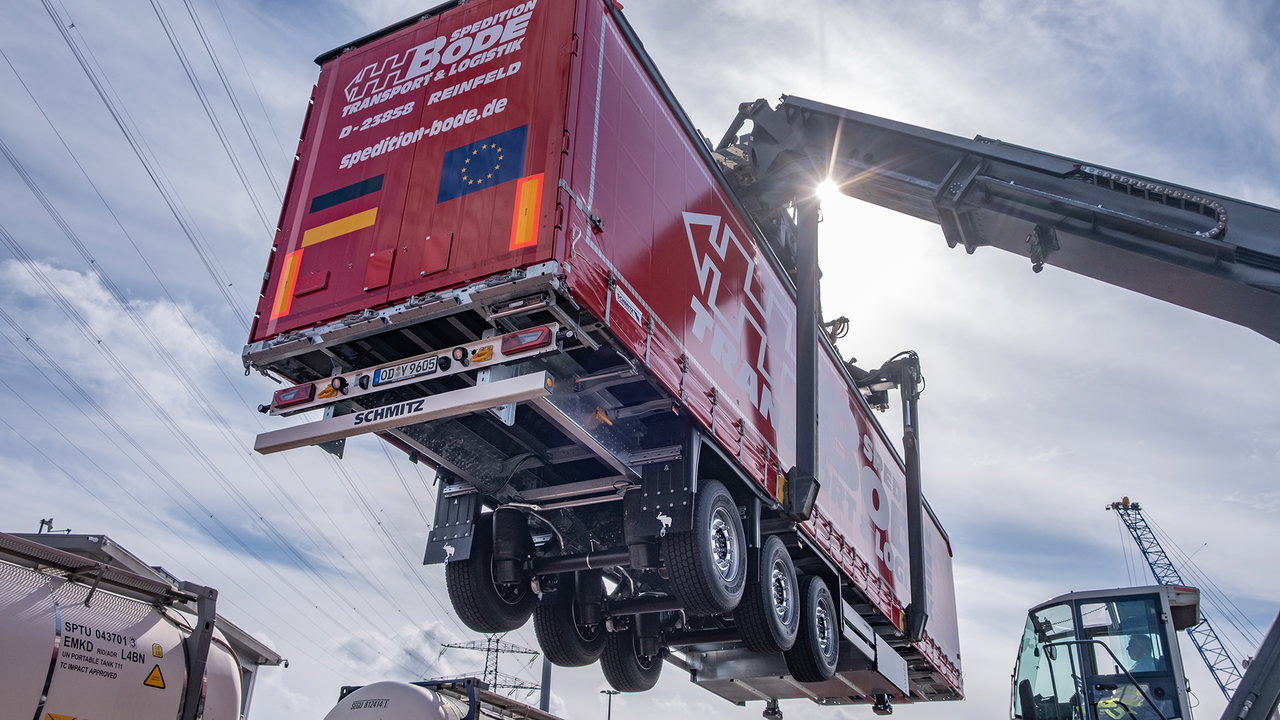
Precision work at the CTL in Lübeck: A reach stacker lifts the Schmitz Cargobull S.CS semi-trailer curtainsider onto the railway wagon.
By train to Stockholm
The company’s own train has a long history. The railway has been part of Bode’s story since its foundation. In 1949, the company began as a ‘railway-authorised haulage contractor’. In 2015, the company acquired its first dedicated train for intermodal transport. Since then, the ‘Alte Schwede’ has been running three times a week between Lübeck and Stockholm, whilst another train carrying flatbed wagons connects Malmö in southern Sweden with Stockholm three times a week. This second route was established as a ‘Plan B’ for the not entirely unlikely eventuality that the sole rail link from Lübeck via Hamburg might become disrupted. But it is not only on routes to Scandinavia that Bode’s trailers travel by rail. They also cover long distances by rail in intermodal long-distance transport within Germany and to Italy.
It is the customers who set the pace. “Our customers want their goods to be transported by rail,” says Kai Bode, Managing Partner. Rail transport is certainly not the cheapest solution, says Bode, but no other mode of transport can move goods with as few CO₂ emissions as rail. The fact that transhipment in Lübeck runs smoothly is also down to the location. The CTL, where the “Alte Schwede” is loaded and unloaded, borders directly on the Bode site at Lübeck’s Seelandkai. “Our collaboration, particularly with Terminal Manager Peter Kopitzke, has been working exceptionally well for more than ten years,” says Managing Director Stev Etzrodt.
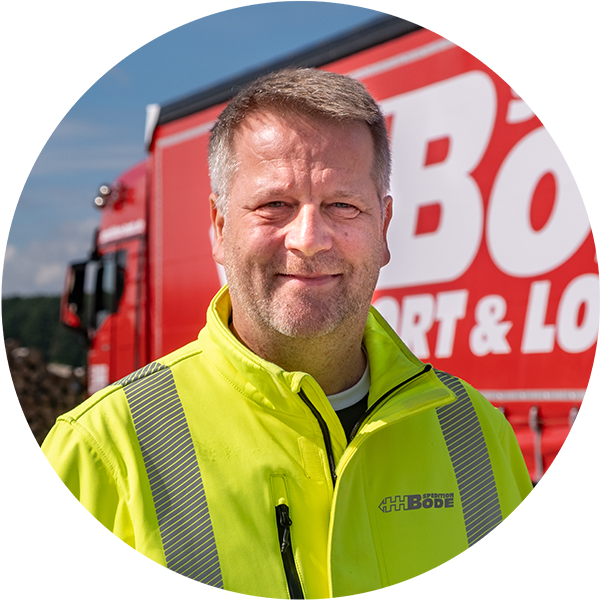
“Our trailers have to be up to the job.”
Stev Etzrodt, Managing Director
Robust for two modes of transport
For the trailers, day-to-day intermodal operations are a tough test. Frequent coupling and uncoupling, and handling with a reach stacker – all this calls for a robust design and solid build quality. On the railways, there are additional forces at play that are hardly a factor in road transport. When a train rushes past on the adjacent track, the wind pressure hits the tarpaulin with full force. “Our trailers really have to be able to cope with a lot,” says Etzrodt.
It is precisely for this purpose that Bode recently took delivery of 50 S.CS semi-trailer curtainsiders from Schmitz Cargobull. The specification includes a galvanised chassis for long-lasting corrosion protection, as well as special gripping edges for rail transport. The bodywork is also designed for heavy-duty use. Its strength is certified to DIN EN 12642 Code XL, and it also meets the requirements of the beverage transport certificate. This makes the semi-trailers suitable for a wide variety of loads, from paper rolls and beverages to general cargo.
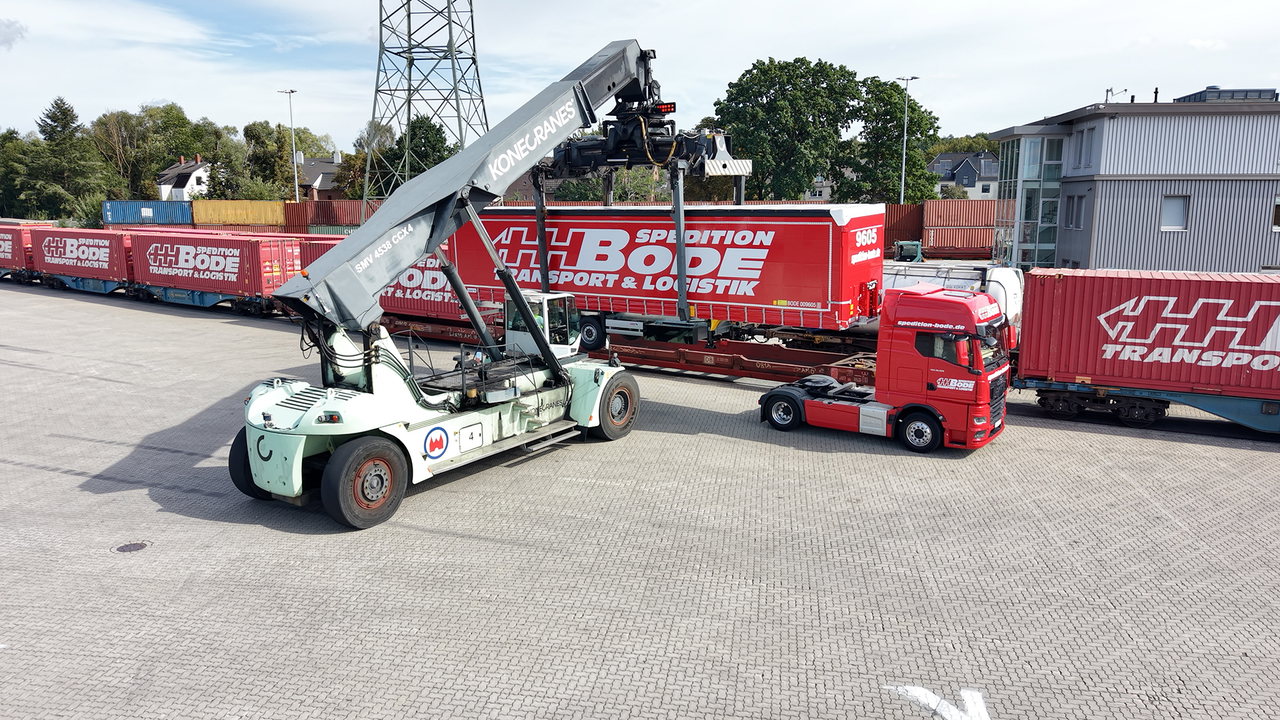
The company’s own train transports containers and rail-loadable semi-trailers from Lübeck to Stockholm three times a week.
“We need vehicles we can rely on in our day-to-day operations,” emphasises Bode. “The new semi-trailer curtainsiders offer the quality and cost-effectiveness we need for our transport operations. At the same time, in Schmitz Cargobull we have a partner who understands our requirements and supports us over the long term.”
Paper supplies as required
Not every new trailer is fitted in the same way. Some of the fleet are S.CS PAPER models, featuring Joloda rails in the floor. Heavy paper rolls can be moved along these rails using rollers and securely lashed down. The remaining semi-trailers do not have this feature. The reason is simple: not every journey requires the paper-handling equipment, and every kilo of equipment reduces the payload. This ensures that Bode has the right vehicle for every job.
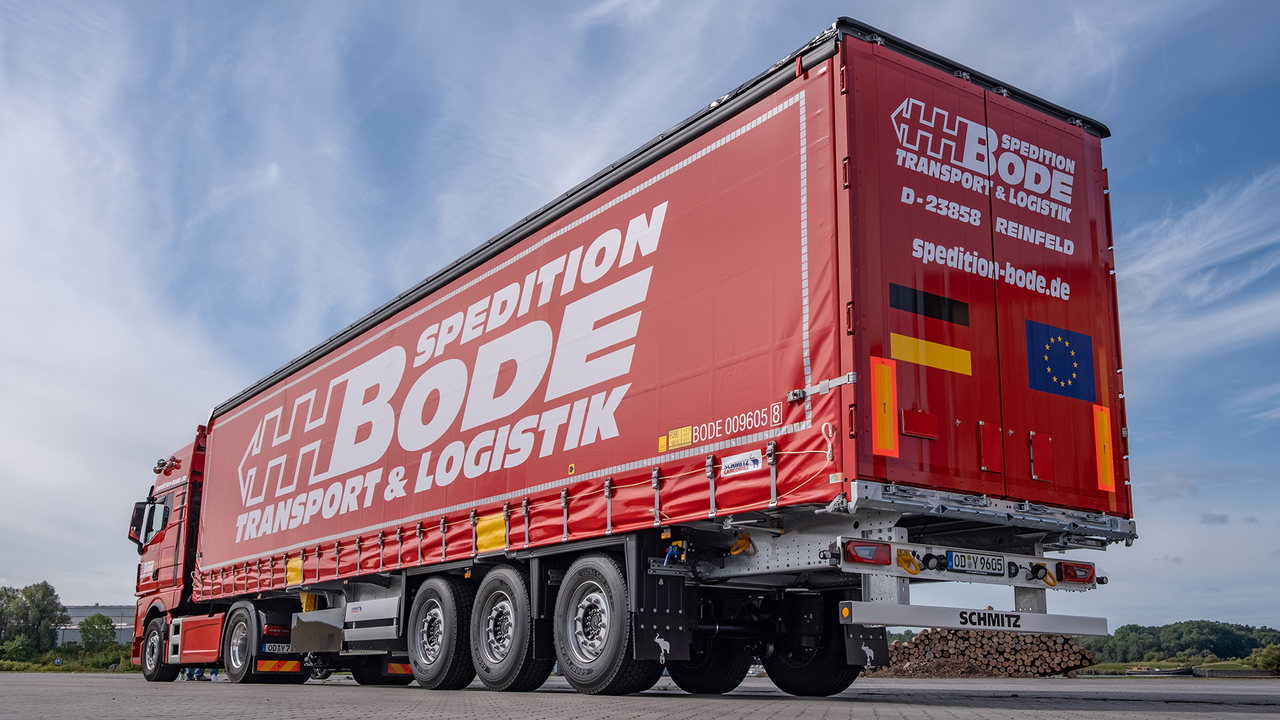
Galvanised chassis, bodywork with Code XL certification. The S.CS semi-trailer curtainsiders, which can be loaded onto trains, are well equipped to cope with the stresses of intermodal transport.
A new colour for the rail
One detail makes drivers’ day-to-day lives noticeably easier. On Bode’s trains to Sweden, flat-bed wagons with long trailer troughs are used. As a result, the trailers no longer require a folding underrun protection device. There is no longer any need to fold them up before loading or fold them down afterwards. Fewer mechanical components also mean less maintenance.
The colour scheme also reflects practical considerations. Originally, all vehicles, superstructures and containers in the Bode fleet were painted white with red lettering. However, the downside of this quickly became apparent on the railways. “Light-coloured vehicles get very dirty when travelling by rail. They soon started to look grubby,” says Bode. Today, the entire fleet is painted in a bold red with white lettering. “It looks good and is much easier to maintain.”
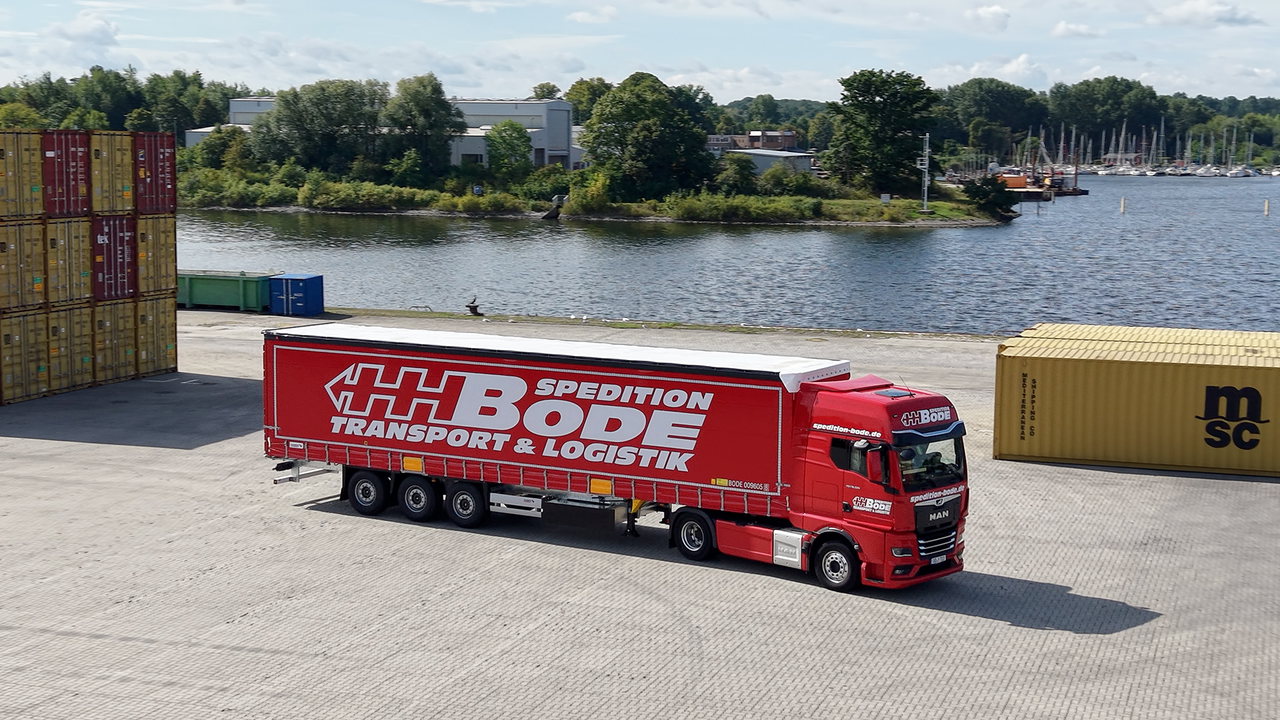
As white vehicles get dirty very quickly when used on the railways, Bode has switched its entire fleet to red.
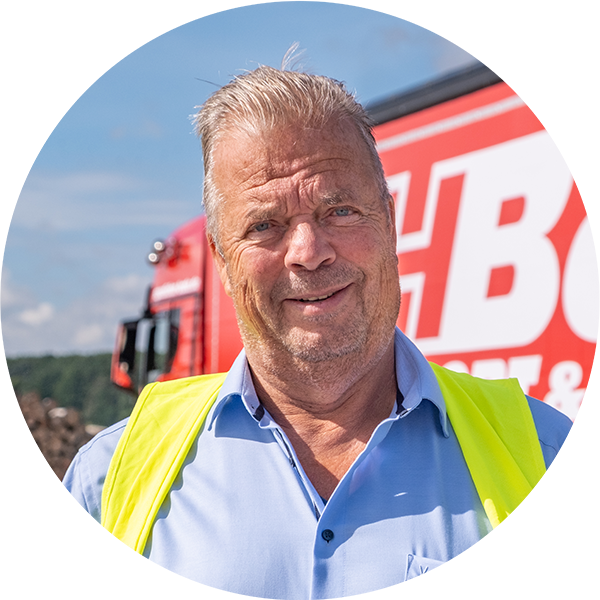
“Thanks to their galvanised chassis, Schmitz Cargobull semi-trailers are extremely durable.”
Kai Bode, Managing Partner
A second life for refrigerated semi-trailers
Whilst intermodal transport places considerable demands on trailers on the one hand, it also goes easy on the vehicles on the other. After all, vehicles that cover long distances on rail hardly clock up any kilometres on the road. Several Schmitz Cargobull refrigerated trailers, some of which are a decade old, in Bode’s fleet currently have a mileage of just around 250,000 kilometres. Take them out of service? Not an option for Bode. The trailers are refurbished and fitted with a new refrigeration unit, after which they’re fit for another few years of everyday transport use. “Thanks to the galvanised chassis, Schmitz Cargobull’s semi-trailers are extremely durable and retain their value very well,” says Bode, speaking from experience. “After refurbishment, they’ll easily last another ten years.”
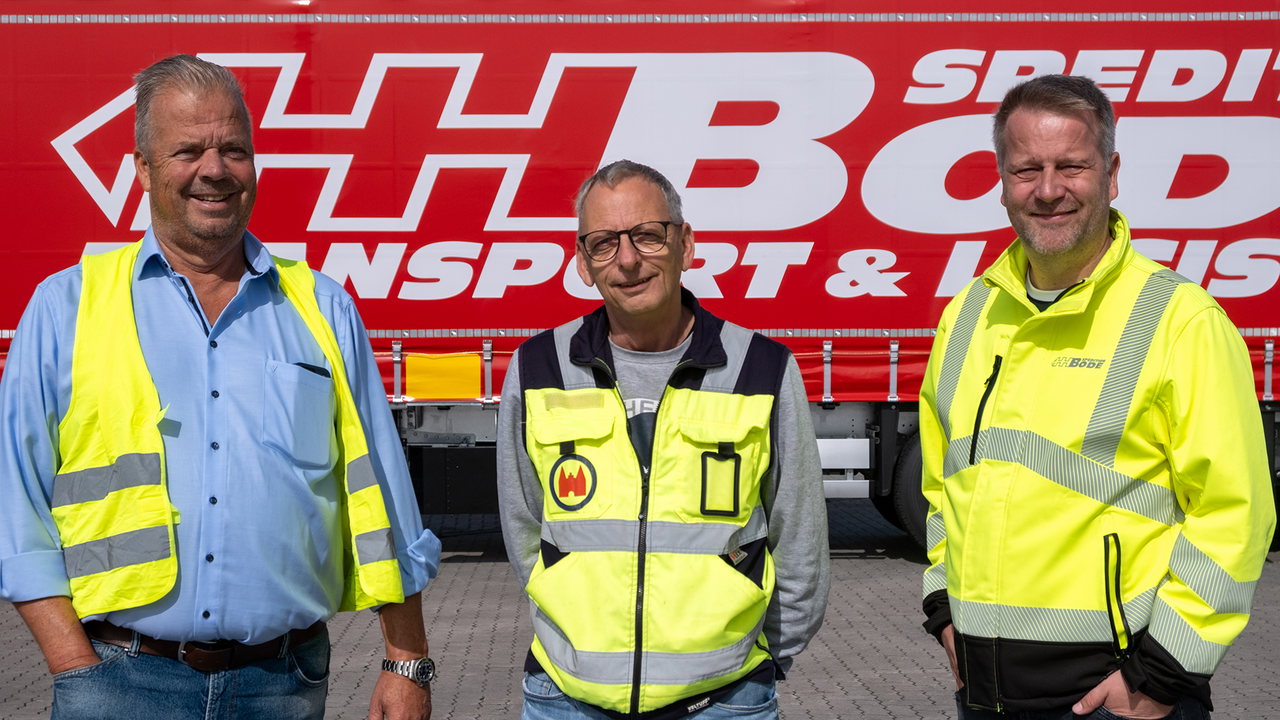
They have been working well together for years: Kai Bode, Managing Partner at Spedition Bode; Peter Kopitzke, Terminal Manager at CTL; and Stev Etzrodt, Managing Director at Spedition Bode.
About Bode Freight Forwarding
Spedition Bode GmbH & Co. KG has its head office in Reinfeld (Holstein) and a branch in Lübeck. Hans-Hermann Bode founded the company in 1949. Today, Kai Bode and his son Marc-Philipp Bode run the company as Managing Partners, together with Managing Director Stev Etzrodt. Around 300 employees manage approximately 1,000 units. All trailers are rail-compatible. The company specialises in contract logistics and intermodal transport along the corridor between Scandinavia and the Mediterranean region.