VECTO for trailers
Out of this world
By including trailers in the VECTO classification system, the EU legislator is taking a course of action that is as ambitious as it is misleading. Unless something changes, these technically unachievable requirements will lead to massive price increases from 2030 onwards.
The cut-off date was 1 January 2019: Since then, European commercial vehicle manufacturers have been required to provide customers purchasing new vehicles with a VECTO certificate detailing fuel consumption and CO₂ emissions. The scheme began with two- and three-axle vehicles (4x2 and 6x2) weighing 16 tonnes or more used in long-distance and regional transport, before other categories were gradually added, including all-wheel-drive vehicles up to 8x8.
It didn’t stop at lorries: at the turn of the year 2023/2024, buses followed, and most recently, trailers and semi-trailers have come under scrutiny. On 1 July 2024, EU Regulation 2024/1610 came into force, setting legally binding CO₂ emission reduction targets for towed units as well: a 10 per cent reduction for semi-trailers and a 7.5 per cent reduction for trailers. If these targets are not met, fines of €4,250 per new vehicle and per gram of CO₂ per tonne-kilometre will be payable from 2030 (equivalent to approximately €15,300 per semi-trailer).
“The economic incentive comes from CO₂ taxation. VECTO for trailers must be scrapped, and we need fewer rules; we need more freedom.”
Andreas Schmitz, Chief Executive of Schmitz Cargobull AG

However, as trailers themselves do not emit any CO₂ apart from those fitted with diesel-powered refrigeration units – this is a purely theoretical consideration: The VECTO tool is designed to determine, on the basis of parameters such as weight, aerodynamics and rolling resistance, the impact of the towed unit on the fuel consumption of the lorry or tractor unit. “Anyone can imagine that this has absolutely nothing to do with reality,” says Andreas Schmitz in an interview, in which he also discusses more practical CO₂ assessments and economic incentives. Incidentally, even if a trailer is used exclusively with an electric tractor unit, it still has to meet the theoretical diesel savings targets.
Unrealistic requirements and an overly simplistic diagram
Kai Dünow, Head of Development for Complete Vehicle Management at Schmitz Cargobull, also criticises unrealistic targets and overly theoretical assumptions in the VECTO classification system. “It would make sense to consider the transport task and the associated CO₂ emissions. Or, to put it another way: I need to move 25 tonnes or 100 cubic metres, and how do I do that most efficiently? VECTO, however, always assumes the same payloads; that’s too simplistic.”
Furthermore, VECTO assesses equipment such as tail-lifts, double-deck fittings, on-board forklifts or intermodal capability (rail loading, ferry transport) are viewed negatively from a weight perspective, even though it is precisely these features that make efficient – and ultimately CO₂ saving – transport possible in the first place. The “perfect VECTO trailer”, by contrast, would be extremely light, just three metres high, aerodynamically optimised and without any additional equipment. “That’s possible, but it would then require three semi-trailers instead of two for the same transport task,” comments Kai Dünow critically.

"The results of the VECTO simulation do not reflect reality."
Diederick van Haselen, Global Equipment Director at the TIP Group
Diederick van Haselen, Global Equipment Director at the TIP Group, also addresses this lack of real-world relevance: “The results of the VECTO simulation do not reflect reality. Aerodynamics only come into play at higher cruising speeds. Furthermore, wind deflectors are constantly being damaged in practice and cannot be used in intermodal transport. Lightweight construction results in reduced robustness: the service life of lightweight semi-trailers is up to 8 years, whilst robust trailers remain in service for around 12 years. This means that 1.5 times as many trailers have to be built. This leads to higher CO₂ emissions!”
Heavy fines, and in the end it’s the consumers who foot the bill
However, if trailer manufacturers continue to build their semi-trailers the way customers need them, rather than the way VECTO would like them to be, hefty fines will be unavoidable from 2030 onwards. This is also one reason why leading trailer manufacturers from Germany, Austria and Poland, including Schmitz Cargobull, have lodged appeals against key provisions of EU Regulation 2024/1610.
The case is currently (as of July 2026) before the European Court of Justice and seeks to establish regulations that take real-world transport conditions into account whilst remaining economically viable. Time is also of the essence, indirectly from the customers’ perspective: manufacturers are already having to make decisions on far-reaching investments, which are then unavailable for other, more effective developments.
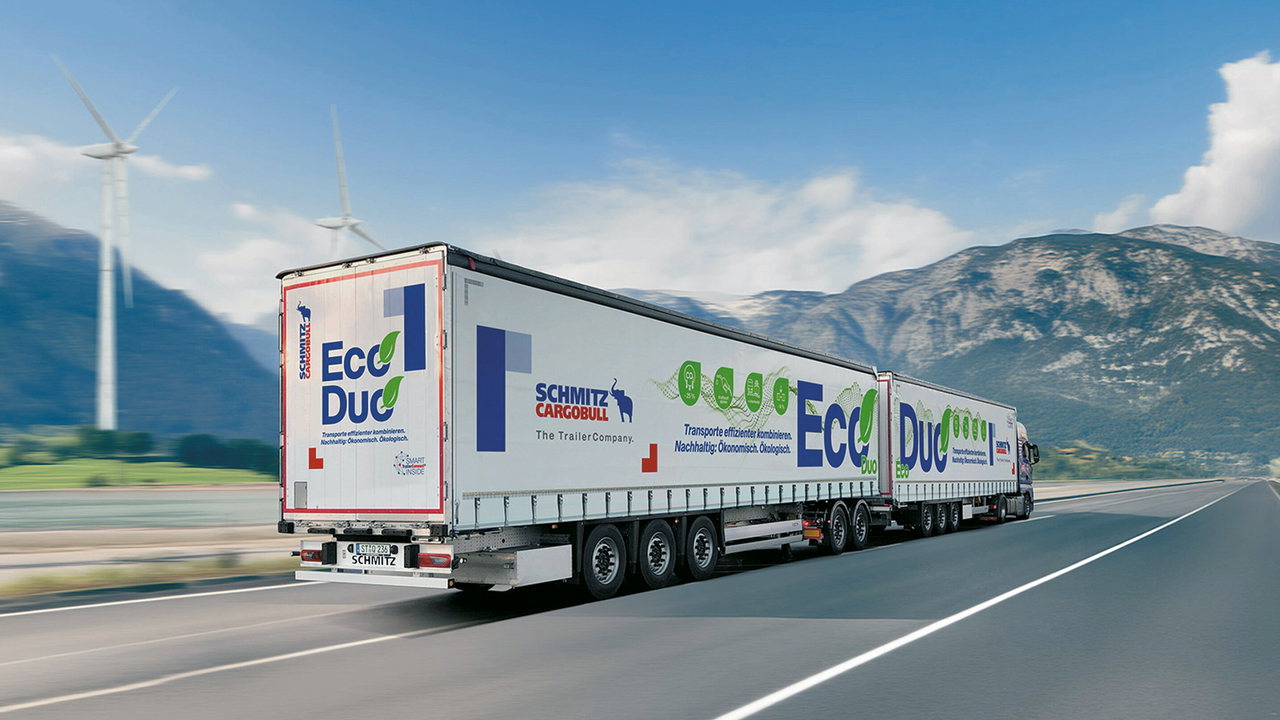
There is no need for unrealistic VECTO targets: innovative transport concepts such as the EcoDuo are already enabling significant CO₂ savings to be achieved.
Should VECTO remain the central CO₂ control mechanism, Kai Dünow puts forward three key demands: “Firstly, the fines are far too high in relation to the size of the company. For Schmitz Cargobull, this amounts to more than one hundred million euros a year – every single year,” he explains. No European trailer manufacturer could afford not to factor these costs into their price calculations. As a result, new curtainsiders, box trailers and refrigerated trailers would become between 20 and 40 per cent more expensive from 2030 onwards.
“VECTO will lead to a huge rise in prices,” Diederick van Haselen is also certain. “And ultimately, it will be the consumers who foot the bill. Manufacturers will pass on the VECTO penalty to vehicle users, who in turn will pass it on to European consumers.”

“VECTO always assumes the same payloads; that’s too simplistic.”
Kai Dünow, Head of Development for Complete Vehicle Management at Schmitz Cargobull
Lowering and phasing in the reduction targets as a minimum requirement
“Secondly, the timeline is too ambitious,” Kai Dünow continues. “We don’t have a phased approach like we do for lorries; instead, it goes from zero to 10 per cent.” That leaves the third point, and this is crucial: “The reduction target of minus 10 per cent is simply not achievable on average for the entire fleet with the options currently available.”
In summary, he states: “We would need at least a reduction to a realistic 7.5 per cent, phased in at 5 per cent initially, followed by a further 2.5 per cent after five years. These measures must be discussed and implemented as early as 2026, as part of an early review of the VECTO Regulation, which is not currently scheduled until the end of 2027.”
There is some cause for hope, as the EU had originally envisaged a rate of 15 per cent, which was subsequently reduced to the current 7.5 per cent for trailers and 10 per cent for semi-trailers. For the time being, the measures apply to ‘box-shaped’ units, primarily curtainsiders and box semi-trailers. Container chassis are exempt, as are tippers and all other body types. However, this does not necessarily mean that the EU will not include further vehicle types in the future.
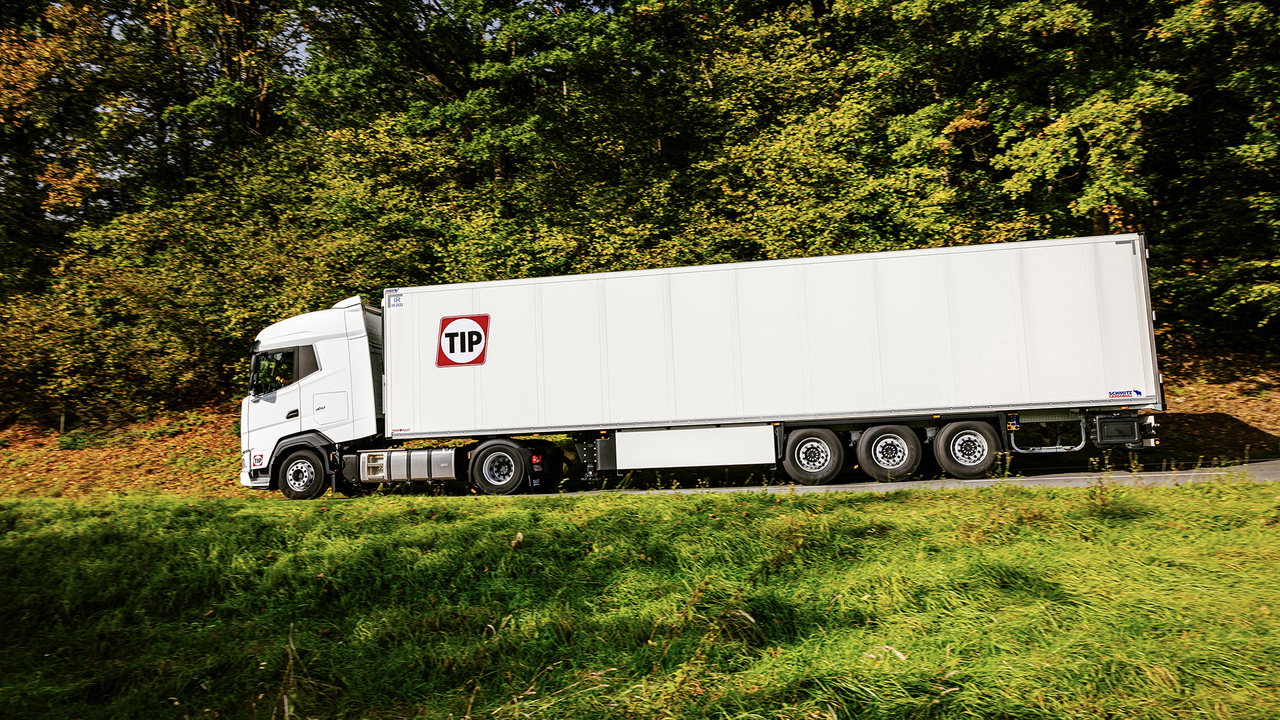
VECTO Trailers are (for the time being) designed for ‘box-shaped’ units such as curtainsiders and semi-trailers.
The scope for even coming close to the VECTO targets is limited. Key factors include tyres, aerodynamics, the electrification of refrigerated semi-trailers (expected to be taken into account in VECTO from the end of 2026) and weight. “Tyres are actually the biggest lever for change, but that’s not enough,” says Dünow. Added to this is the fact that VECTO does not take into account operating conditions that influence tyre choice in practice. “Today’s Class A rolling resistance tyres are primarily suited to long-distance transport; their use in local and regional transport is limited. In these situations, more robust Class B or even Class C tyres are currently used.” Of course, lorry and trailer manufacturers are in discussions with tyre producers, but it remains to be seen whether the latter will be able to pull a trick or two out of their sleeves.
Background information on VECTO
CO₂ emissions are calculated using the VECTO (Vehicle Energy Consumption Calculation Tool) simulation programme; in the case of semi-trailers and trailers, VECTO Trailer is used. VECTO is made available by the European Commission as open-source software and is implemented by the manufacturers themselves.
“We, too, have integrated VECTO into our business software,” reports Kai Dünow. “The certificates issued relate to each individual vehicle. There are no standardised groups for trailers of the same design.” Once the required parameters have been entered – some of which are determined and audited in-house, whilst others are provided by the tyre manufacturer, for example – the actual VECTO simulation takes around one to two minutes to produce a data set.
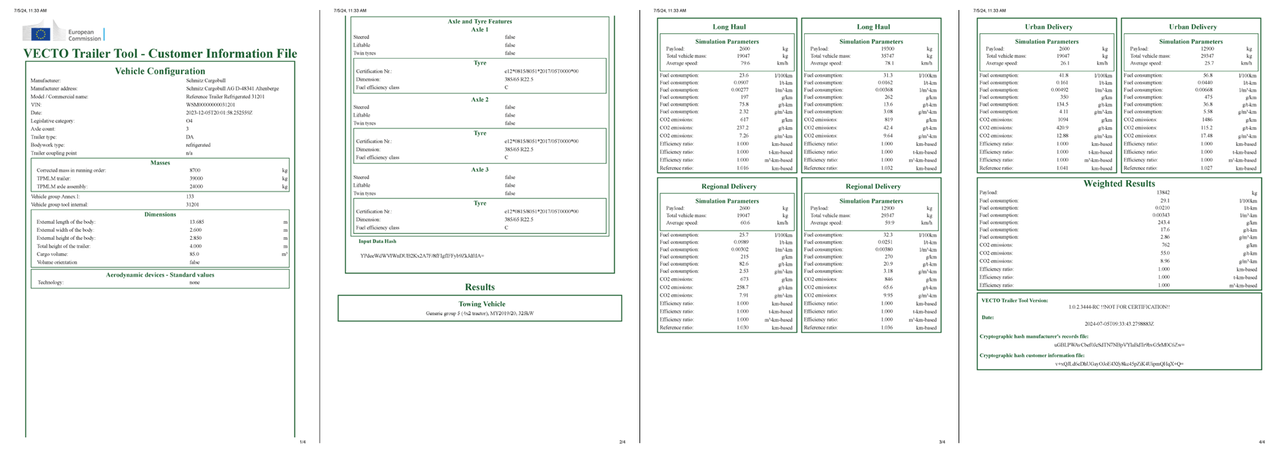
As shown in this example of a refrigerated semi-trailer, calculated for illustrative purposes, this is roughly what a future VECTO certificate issued to the customer would look like.
A one-year monitoring phase is currently underway to set the CO₂ targets, which are due to come into effect on 1 July 2030. “For the ‘box-type semi-trailers’ concerned, there are essentially nine sub-groups in the VECTO system that are relevant to Schmitz Cargobull’s portfolio, including, for example, mega semi-trailers, dry freighters and refrigerated trailers,” explains Kai Dünow. “Each sub-group has its own target value, and to determine this, annually recurring registration periods are taken into account and an average is calculated.” The data collected – the provision of which, incidentally, keeps manufacturers quite busy – is then sent to the European Environment Agency.
In principle, all VECTO data – that is, data relating to lorries, buses and trailers – is centrally recorded and assessed by the European Commission. This means that it can also serve as a potential basis for future limit regulations, tolls, taxes and levies.